

Education and Industry Alignment: Rethinking Skill-Based Curriculum

As workplaces transform under the pressure of emerging technologies and shifting skill demands, conventional educational models alone can no longer prepare students for the challenges of tomorrow. Automation, digital transformation, emerging technologies, and new business models are reshaping workforce expectations, making traditional academic pathways insufficient on their own. As a result, there is increasing urgency to build a curriculum that keeps pace with dynamic skill requirements while also developing adaptability, problem-solving abilities, creativity, and resilience in learners, enabling them to contribute meaningfully across diverse contexts. The challenge lies in designing a curriculum that preserves academic depth, ensures inclusivity, and accommodates varied learning pathways. This article explores the core principles, strategies, and implementation approaches necessary to rethink skill-based curriculum development, drawing on the provided references and additional insights from contemporary educational research.
The Need for Stronger Alignment between Education and Industry
Education often moves more slowly than industry, which continuously reinvents roles and competencies. The 2025 Institute of Student Employers (ISE) Student Development Survey found that 54% of employers felt graduates lacked sufficient self-awareness and 46% raised concerns about their resilience, indicating that gaps in workplace demands and early-career readiness continue to persist. Many employers report a gap between graduates’ abilities and the skills required in real-world environments. A 2023 report from Wiley found that 69 percent of HR professionals believe their organizations face a skills gap, a sharp increase from previous years. This gap expands whenever curriculum review cycles are lengthy or based primarily on academic priorities rather than external demands.
Industries today require workers who can apply knowledge to practical contexts, operate tools and technologies confidently, interpret data, collaborate in diverse teams, and solve problems without dependence on rigid instructions. Reviewing skill-based curriculum development through this lens keeps institutions relevant and supports students in navigating unpredictable career paths.
Principles Guiding a Skill-Based Curriculum
These principles provide structure to curriculum development while supporting long-term adaptability.
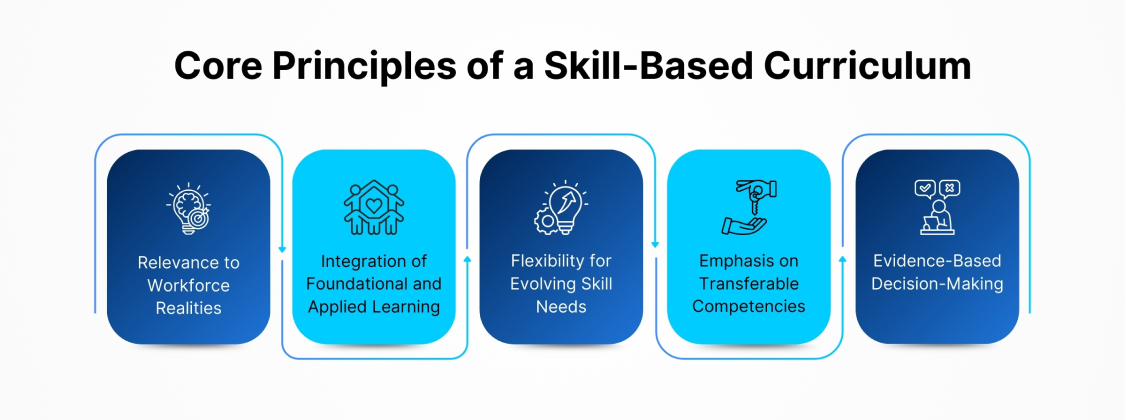
1. Relevance to Workforce Realities
Curriculum design must be anchored in real industry requirements. This involves continuous research on market shifts, job roles, workplace tools, and skill demands. Relevance ensures students graduate with competencies that businesses actively seek.
2. Integration of Foundational and Applied Learning
A balanced curriculum connects theoretical understanding with hands-on learning. This combination strengthens conceptual clarity while preparing students for real tasks. Applied learning builds confidence and makes students more productive when they transition to professional environments.
3. Flexibility for Evolving Skill Needs
Industries do not remain static. A well-designed curriculum includes flexible components that can be updated with minimal disruption. Modularity (learning broken into independent, stackable components), optional micro-learning units (short, focused lessons designed to build specific skills), and interdisciplinary courses support this flexibility.
4. Emphasis on Transferable Competencies
Critical thinking, communication, digital literacy, teamwork, adaptability, and ethical reasoning are essential in every field. Curriculum development must embed these competencies across subjects rather than limit them to isolated modules.
5. Evidence-Based Decision-Making
Curriculum changes should rely on data from employer surveys, alumni feedback, graduate outcomes, job-market analytics, and research trends. Using data ensures that interventions are grounded in genuine needs rather than assumptions. This aligns with referenced studies emphasizing the use of insights to enhance curriculum relevance.
Building on these principles, institutions can apply various strategies to bridge education and industry needs.
Strategies for Strengthening Education and Industry Alignment
Effective alignment requires structured approaches that bring educators and industries closer.
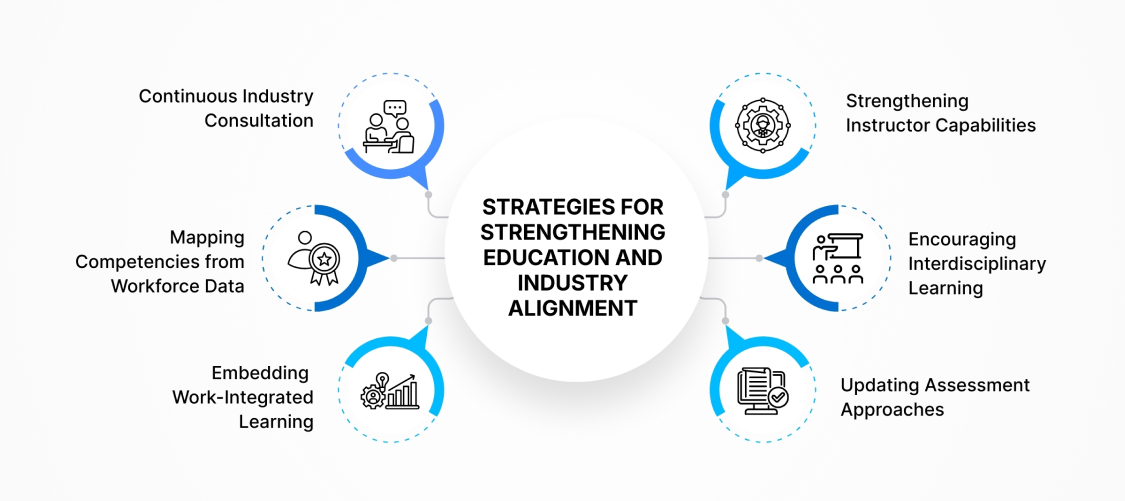
1. Continuous Industry Consultation
Regular discussions with employers, professionals, and technical experts help identify emerging trends, tools, and knowledge areas. Advisory groups, sector committees, and periodic consultations allow institutions to update learning pathways more accurately. Insights from the Watermark reports emphasize the importance of gathering real-world input to guide curriculum advancements.
2. Mapping Competencies from Workforce Data
Institutions can analyze job descriptions, hiring patterns, required qualifications, and skill categories from multiple industries. Competency mapping (the process of identifying the skills and behaviors required for specific roles) helps identify essential skills and performance expectations. Aligning learning outcomes with these competencies supports smoother student transitions.
3. Embedding Work-Integrated Learning
Work-integrated learning such as internships, apprenticeships, simulations, case-based learning, project collaborations, and lab practice deepen students’ applied knowledge. According to a 2024 report by Strada Education Foundation, most students who participate in work-based learning feel it has made them significantly better job candidates, especially in building technical skills and professional networks. These experiences acting as bridges between textbook content and workplace situations, improve confidence and job readiness. Contemporary research consistently shows that, work-integrated learning also helps students develop communication, planning, and self-management skills.
4. Strengthening Instructor Capabilities
Educators must be comfortable with industry tools, digital platforms, and contemporary practices. Regular training, peer exchange, industry short courses, and exposure programs help them incorporate relevant examples in their teaching. When instructors stay updated, the curriculum remains dynamic.
5. Encouraging Interdisciplinary Learning
Jobs increasingly require the ability to work across domains. Curriculum that encourages interdisciplinary approaches gives students broader perspectives and prepares them for hybrid roles. Combined learning paths also help learners build adaptability.
6. Updating Assessment Approaches
Assessments should test real application of knowledge. Authentic tasks, problem-solving exercises, portfolio submissions, practical examinations, and reflective activities create a more accurate picture of student capability. This aligns with trends highlighted in several online education research sources.
Implementing a Skills-Aligned Curriculum with Future Industry Needs
Transitioning to a skill-based model requires planning, collaboration, and continuous improvement.
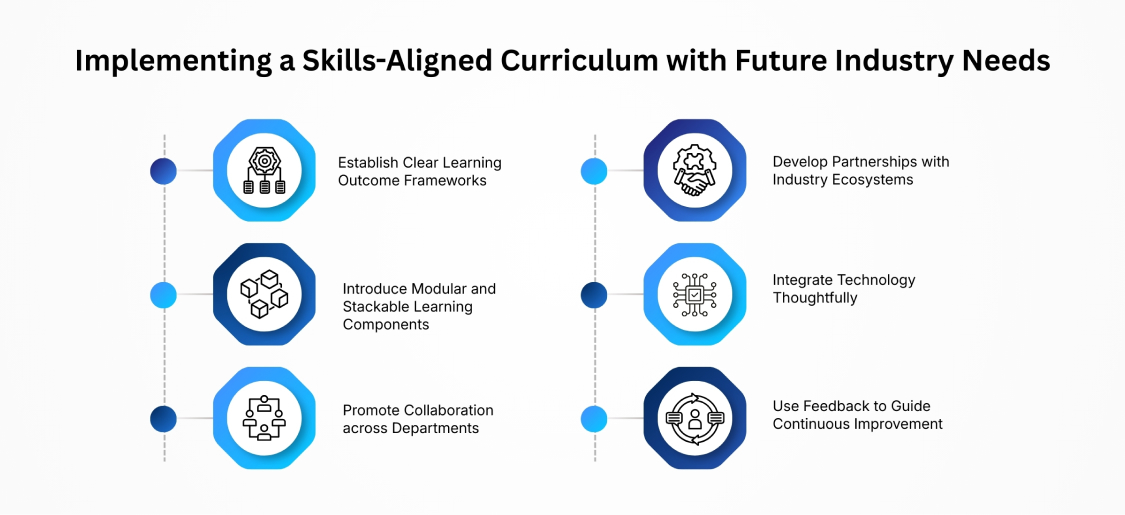
1. Establish Clear Learning Outcome Frameworks
Institutions should begin by defining competencies that students must demonstrate by the end of each program. These include technical capabilities, workplace behaviors, and core reasoning abilities. Well-structured outcomes guide course content, teaching methods, and assessments.
2. Introduce Modular and Stackable Learning Components
Modular curriculum structures allow easier updates to specific topics without changing entire programs. Stackable components (small learning units that can be combined to form larger qualifications) help learners pursue short courses, micro-credentials, or specializations that can accumulate into larger qualifications. This approach widens access and supports lifelong learning.
3. Promote Collaboration across Departments
Academic teams, administrative units, and technical staff must work together when revising curriculum structures. Collaboration ensures alignment between learning outcomes, assessment methods, and educational policies. It also helps avoid isolated decision-making.
4. Develop Partnerships with Industry Ecosystems
Although the article avoids naming organizations, partnerships can include multiple sectors. Institutions can collaborate with professionals for guest sessions, short workshops, real project assignments, and updated insights about industry trends. These partnerships reinforce skill development and expand learning opportunities.
5. Integrate Technology Thoughtfully
Digital tools, simulation environments, analytics platforms, and online labs enable students to engage with real-world scenarios within controlled settings. Technology integration should be purposeful, ensuring meaningful learning rather than simple digitization.
6. Use Feedback to Guide Continuous Improvement
Student feedback, employer inputs, graduate performance data, and academic review findings should be reviewed periodically. Institutions must revise programs whenever gaps appear. A cycle of feedback and refinement prevents the curriculum from becoming outdated.
Despite these approaches, several challenges impact skill-based curriculum reform.
Challenges and Risk Areas in Skill-Based Curriculum Reform
Aligning curriculum with industry needs comes with practical and structural challenges. Recognizing these risks helps make reforms more effective and sustainable.
1. Rapid Shifts in Industry Skill Requirements
Industries evolve quicker than academic revision cycles, which makes it difficult for programs to stay current. For instance, the World Economic Forum’s 2025 Future of Jobs Report estimates that about 39% of existing core skills among today’s workforce will become outdated by 2030, highlighting the urgent need for continuous learning and curriculum-industry alignment. Without continuous trend monitoring and frequent updates, institutions risk offering outdated learning outcomes.
2. Limited Faculty Preparedness and Support Structures
Moving to a skill-based approach requires new teaching and assessment methods. Many faculty members need training, resources, and institutional support to confidently embed competencies into their courses.
3. Balancing Academic Depth with Practical Skill Demands
Practical skills are important, but academic programs also need conceptual rigor. Finding the right mix between theoretical understanding and workplace relevance remains a persistent challenge.
4. Resource and Budget Constraints
Effective reform involves technology upgrades, new tools, and sometimes specialized staff. Institutions with limited budgets may struggle to implement changes at the scale required for real impact.
5. Assessment Redesign Challenges
Competency-based learning depends on applied assessments, projects, and performance tasks. The “Trends in Assessment in Higher Education” report from Jisc (2025) highlights significant challenges in redesigning assessment, including decreasing institutional resources and the urgent need to rethink exams in light of generative AI. Redesigning these across programs takes time, coordination, and careful quality control.
6. Weak or Inconsistent Industry Engagement
Curriculum alignment depends on strong, ongoing industry collaboration. When partnerships are minimal or irregular, institutions lose valuable insight, and fewer opportunities arise for real-world learning experiences.
7. Resistance to Organizational Change
Transitioning to a skill-centered model disrupts established academic routines. Departments vary in readiness, and some may perceive alignment work as difficult or unnecessary without clear guidance and leadership support.
8. Overemphasis on Immediate Skills
Focusing too heavily on current job requirements can limit students' long-term adaptability. A strong model balances role-specific capabilities with transferable skills that remain useful over time.
9. Inequity in Access to Skill-Building Opportunities
Skill-based programs often rely on technology, projects, or industry exposure, and not all students can access these equally. Recent UNESCO UNEVOC findings from 2025 indicate that despite improvements in digital availability, a significant access gap persists, as many learners continue to face barriers related to device affordability and limited internet connectivity, which restricts equitable participation in skill building opportunities.
Looking beyond immediate obstacles, broader perspectives guide sustainable curriculum evolution.
Broader Considerations for the Future
Building alignment is a long-term responsibility. Institutions must look beyond short-term industrial needs and prepare students for a future of constant change. As technology advances, new jobs will emerge, current roles will evolve, and some may decline. Skill-based curriculum development must consider these uncertainties while staying grounded in essential learning.
Another consideration is inclusivity. Not all learners have equal access to digital tools, industry exposure, or financial resources. Curriculum planning must ensure fair opportunities for all students. Likewise, ethical reasoning, sustainability awareness, cultural sensitivity, and social responsibility are becoming essential in workplace environments and should be embedded across learning pathways.
Conclusion
Education and industry alignment is a crucial step toward preparing learners for uncertain and increasingly complex career landscapes. A curricula centered on practical skills, that responds to evolving workforce needs, integrates evidence-based insights, and ensures inclusivity cultivates student competencies while contributing to long-term societal advancement. Adopting clear principles, effective strategies, and thoughtful implementation approaches helps institutions build programs that keep pace with workforce changes. As industries evolve, so must educational systems, ensuring that learners can apply knowledge confidently, adapt to new situations, and pursue lifelong learning.
Latest
Trends blogs
- From Paper to Proof: How Blockchain is Reshaping Academic Credentials
- Executive Education in the AI Era: Shifting Models and New Realities
- Global Education Technology: Growth Drivers, Challenges, and Evolving Trends
- Girls Shaping the Digital Future: Why ICT Skills Are a Must-Have for AI-Driven Careers
Focus blogs