


Building a High-Impact Center of Excellence: What You Need to Know

As organizations push to stay sharp and strategically aligned, the need for structured expertise has never been clearer, leading them to pursue stronger capabilities, streamlined operations, and sustained innovation. A well-built Center of Excellence (CoE) serves as a strategic unit that centralizes knowledge, frameworks, and processes to enhance performance and create organization-wide value. Instead of functioning as another operational department, a CoE becomes a guiding force that brings consistency, accelerates progress, and nurtures continuous advancement.
What Is a Center of Excellence?
A Center of Excellence is a dedicated internal hub designed to consolidate expertise, define standards, and support strategic priorities across the organization. It serves as a structured body that brings together specialists, governance practices, reusable assets, and knowledge-sharing mechanisms. Its ultimate goal is to enable smarter decision-making, strengthen capability, and support long-term transformation. Unlike short-term project teams, a center of excellence provides sustained leadership and ongoing oversight in one particular domain, whether technology, process management, analytics, learning, customer experience, quality systems or more.
Why Establish a Center of Excellence?
A center of excellence delivers value by reinforcing consistency, guiding teams, and enabling informed action.
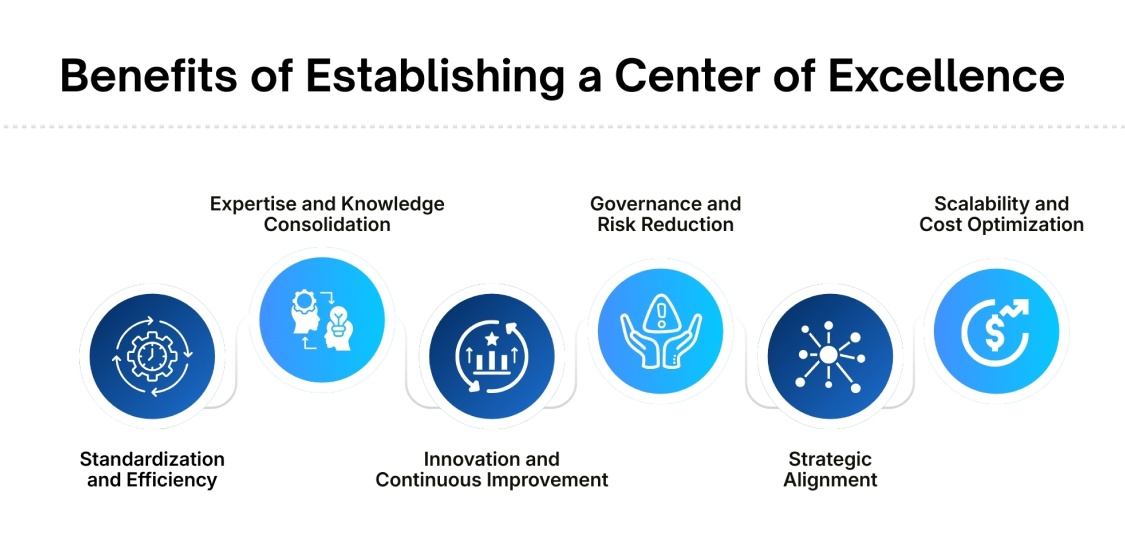
1. Standardization and Efficiency
A CoE helps streamline work by introducing unified frameworks, templates, and methodologies. This reduces unnecessary variation, eliminates repetitive work, and improves overall operational clarity.
2. Expertise and Knowledge Consolidation
It centralizes domain-specific knowledge, allowing experts to collaborate, document proven practices, and guide the broader workforce with dependable insights.
3. Innovation and Continuous Improvement
By dedicating time and resources to experimentation, a center of excellence becomes a catalyst for developing new solutions, assessing emerging technologies, and testing improved approaches.
4. Governance and Risk Reduction
Well-defined controls, quality checks, and compliance mechanisms managed by the center of excellence lower risks, improve accuracy, and create transparency.
5. Strategic Alignment
Because the CoE operates close to leadership and strategy, its initiatives remain aligned with long-term organizational goals, ensuring that efforts contribute to the right outcomes.
6. Scalability and Cost Optimization
Over time, a center of excellence enhances internal capability and reduces reliance on external consultants, ultimately lowering costs while building stronger in-house expertise.
Five Core Foundational Principles for a High-Impact Center of Excellence
A successful Center of Excellence is built on a strong foundation of guiding principles that shape its purpose, structure, and long-term impact. These core elements ensure consistency, alignment, and measurable value across all initiatives.
1. Clear Purpose and Scope
Every center of excellence needs a sharply defined mission, whether it supports digital maturity, process excellence, quality assurance, or innovation. A clear scope helps teams understand priorities and prevents the CoE from becoming overextended.
2. Strong Leadership and Governance
A center of excellence thrives when it has strategic sponsorship, decision-making clarity, and governance structures that outline how standards are created, approved, and monitored.
3. Skill Concentration and Knowledge Hub
The CoE must bring together experts who continuously develop new competencies and create a system that allows the wider organization to benefit through training, documentation, and knowledge sharing.
4. Metrics and Performance Tracking
Establishing key performance indicators ensures the center of excellence remains purposeful and accountable. Measuring impact helps refine activities and justify long-term investment.
5. Sustainable Operating Model
A CoE should be designed for longevity. Its structure, workflows, and resourcing model must remain relevant even as the organization, technologies, or priorities shift.
10 Key Steps to Establish a Successful and Sustainable Center of Excellence
Building a successful and sustainable Center of Excellence requires a structured approach that aligns strategy, people, and processes from the very beginning. These key steps lay the groundwork for long-term effectiveness and measurable impact.
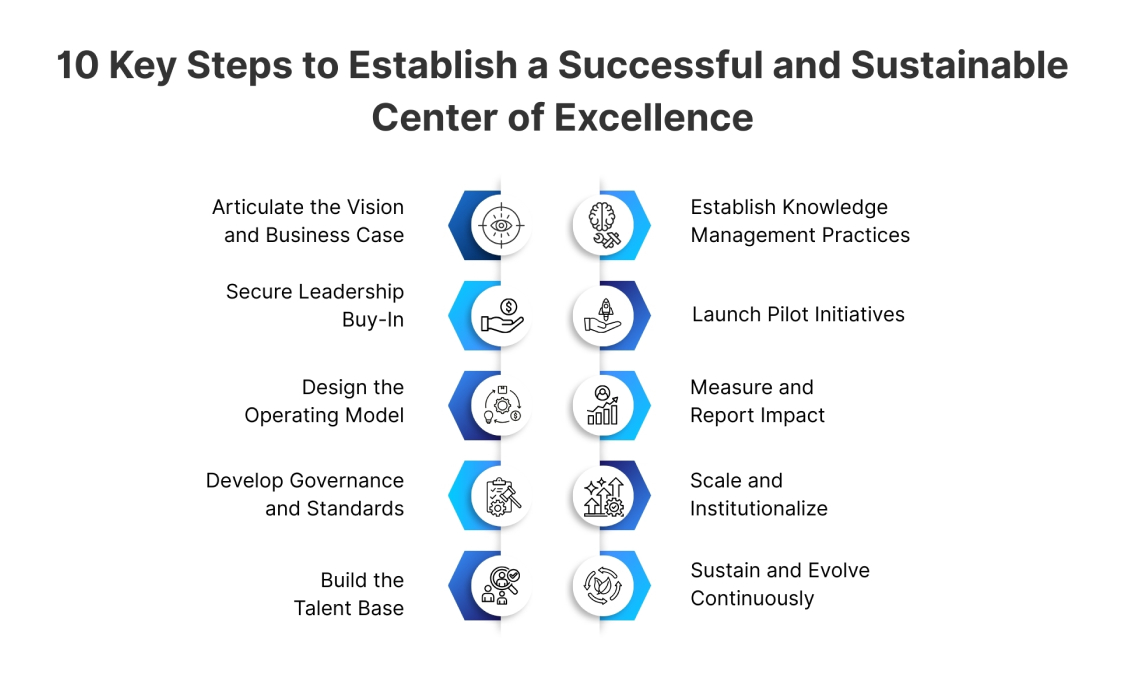
1. Articulate the Vision and Business Case
A center of excellence begins with a compelling and well-structured vision that explains why it is needed, what issues it will solve, and how it connects to strategic priorities. This includes clearly identifying the domain where the CoE will operate, the expected outcomes, and the value it aims to generate. A strong business case helps ensure commitment from leadership and builds confidence in the CoE’s long-term purpose.
2. Secure Leadership Buy-In
Leadership involvement is essential for authority, visibility, and funding. Securing executive sponsorship ensures that the CoE has the power to influence decisions and introduce standards across the organization. A governance or steering group should be formed early, providing oversight, resolving escalations, and ensuring that CoE initiatives align with broader objectives.
3. Design the Operating Model
The operating model defines how the center of excellence runs day-to-day and how it interacts with the rest of the organization. The structure may be fully centralized or built using a hub-and-spoke system, depending on scale and complexity. This step also involves defining roles such as domain experts, governance leads, analysts, and trainers. A well-designed model supports clarity and consistent operations.
4. Develop Governance and Standards
A center of excellence must introduce clear guidelines, policies, frameworks, and reusable assets that improve quality and consistency. Governance defines how these standards are created, updated, communicated, and enforced. It also outlines processes for decision-making, tool selection, documentation, and change management. Effective governance becomes the backbone of CoE credibility.
5. Build the Talent Base
Recruiting or developing skilled professionals is vital to establishing a strong knowledge foundation. These experts not only deliver core CoE functions but also guide other teams through advisory sessions, knowledge-sharing activities, and problem-solving support. Investing in learning and development ensures the center of excellence remains current and influential.
6. Establish Knowledge Management Practices
The CoE should maintain a structured collection of playbooks, templates, learning modules, frameworks, and insights that teams across the organization can access. Knowledge management helps capture lessons, reduce repetitive effort, and maintain consistency. Documentation also ensures that expertise remains within the organization even when individuals move roles.
7. Launch Pilot Initiatives
Pilot projects act as early demonstrations of value. These initiatives should focus on areas where the CoE can show clear improvement such as reducing process delays, improving quality, or implementing a new tool effectively. Pilots provide opportunities to test governance models, validate methodologies, and refine approaches before expanding operations.
8. Measure and Report Impact
Tracking performance ensures the CoE remains accountable and demonstrates return on investment. Metrics may include improvements in efficiency, cost reductions, faster delivery cycles, or higher process compliance. Consistent reporting helps communicate progress to leadership, build credibility, and secure ongoing support.
9. Scale and Institutionalize
Once the CoE proves its value and aligns with organizational needs, it can expand its reach. This may involve adding new service areas, supporting more teams, or formalizing engagement models for consultations, training, or process reviews. Institutionalization occurs when CoE practices become embedded into everyday operations.
10. Sustain and Evolve Continuously
A CoE must remain dynamic, adapting to new technologies, changing business priorities, and emerging trends. Periodic reviews of the CoE’s purpose, structure, and services help refine its contributions. Continuous improvement ensures that the CoE stays relevant and continues to contribute meaningfully to organizational growth.
Measuring Success: Key Metrics to Track the Performance of a Center of Excellence
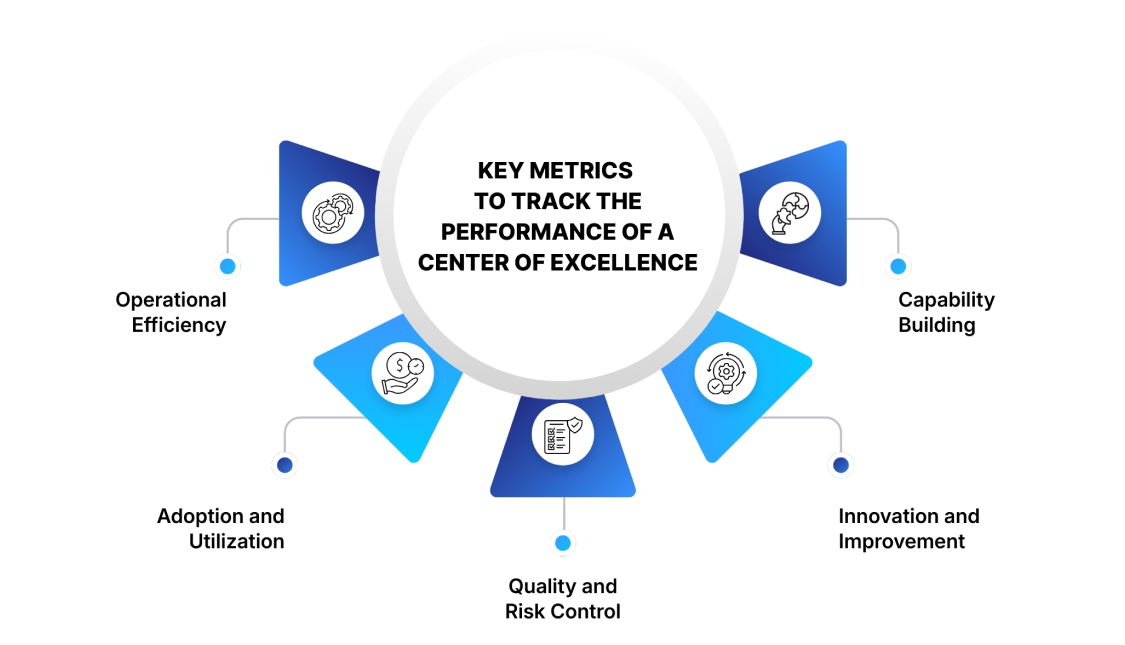
A high-impact CoE evaluates its performance using well-chosen metrics that reflect operational effectiveness, influence, and outcomes. These indicators demonstrate progress and help guide strategic adjustments.
-
1. Operational Efficiency
This measures how effectively the CoE enhances processes and overall operational results. It includes evaluating reductions in process cycle times, fewer instances of rework, and improvements in throughput or delivery speed. Together, these indicators demonstrate the CoE’s impact on streamlining workflows and promoting more effective ways of working. -
2. Adoption and Utilization
A CoE delivers real value only when its frameworks and resources are actively used across the organization. Measuring the number of teams engaging with the CoE, the frequency of tool or guideline utilization, and the rise in recurring requests helps reveal how deeply the organization relies on the CoE’s expertise. -
3. Quality and Risk Control
This focuses on the CoE’s role in elevating accuracy, compliance, and consistency. Tracking decreases in compliance deviations, reductions in defects, and higher adherence to standards reflects the CoE’s contribution to strengthening quality controls and minimizing organizational risks. -
4. Innovation and Improvement
CoEs often act as engines for advancement by identifying new ideas and encouraging experimentation. Monitoring the number of improvement initiatives completed, successful pilot outcomes, and the introduction of new methodologies shows how the CoE drives meaningful innovation and continuous improvement. -
5. Capability Building
A key function of a CoE is to strengthen internal skills and knowledge across teams. Metrics such as total training hours, certifications earned, and participation in learning initiatives indicate how effectively the CoE enhances capabilities and supports long-term competency growth within the organization.
Conclusion
A Center of Excellence becomes truly valuable when it serves as a strategic engine that unifies expertise, introduces consistent practices, and drives improvement across the organization. Building one requires a clear vision, committed leadership, strong governance, capable talent, and a structured approach to implementation. When paired with meaningful metrics and continuous evolution, a CoE not only strengthens operational efficiency but also raises organizational capability, enabling teams to work smarter, innovate confidently, and adapt quickly in a changing environment.
Latest
Trends blogs
- From Paper to Proof: How Blockchain is Reshaping Academic Credentials
- Executive Education in the AI Era: Shifting Models and New Realities
- Global Education Technology: Growth Drivers, Challenges, and Evolving Trends
- Girls Shaping the Digital Future: Why ICT Skills Are a Must-Have for AI-Driven Careers
Focus blogs