

Research-Driven Education: Strengthening Strategies, Policies, and Classroom Practice

Education systems are constantly reshaped by shifting learner needs, new technologies, and evolving social expectations. In this landscape, research functions as a compass that helps decision-makers understand which practices genuinely improve learning and which policies create measurable impact. By generating evidence on how students think, how teachers teach, and how institutions operate, research provides the foundation for meaningful educational progress.
When policymakers, curriculum designers, and educators rely on systematic inquiry rather than assumptions, they are better equipped to design strategies that respond to real challenges. Studies on learning outcomes, assessment patterns, digital adoption, and classroom behaviour reveal trends that would otherwise go unnoticed. This evidence enables education systems to make informed adjustments that strengthen equity, efficiency, and overall learning quality.
Why Research Matters for Education
Research plays multiple essential roles in strengthening education systems:
- It offers empirical data that help decision-makers understand what works and under what conditions. Studies reveal how different teaching approaches, assessment methods, or resource allocations affect learning outcomes, enabling policy and curriculum designers to base choices on evidence rather than assumptions.
- It highlights structural inequities and systemic disparities. When researchers examine access, resource distribution, teaching quality, or learning outcomes across different communities, they help policymakers identify inequities and design targeted interventions.
- It supports innovation in teaching and learning practices. Through experimental and comparative studies, research can show whether novel pedagogies like project-based learning or blended instruction improve student engagement, retention, and performance compared to traditional models.
- It offers accountability and feedback mechanisms. Once education reforms are implemented, research helps evaluate their effectiveness. Tracking outcomes over time, via longitudinal studies or impact evaluations, helps refine policies and prevent wasteful or harmful practices.
Because education intersects with social equity, economic development, and human potential, using research as a foundation ensures that the system evolves responsibly, inclusively, and efficiently.
Core Functions of Educational Research
Through structured inquiry and data analysis, educational research uncovers the mechanisms behind student performance and instructional effectiveness. These insights drive meaningful educational improvement.
-
Evidence-Based Decision Making
Research translates classroom observations, learning trends, and demographic shifts into actionable data. For example, research can show how attendance, socioeconomic background, teacher-student ratios, and pedagogical methods correlate with academic performance. These insights enable policymakers to make informed choices about resource allocation, teacher training, curriculum design, and support services rather than relying on anecdotal or politically driven decisions. -
Policy Formation and Reform
Good educational research influences the drafting and revision of education policies. By providing evidence on what improves learning outcomes, what reduces dropout rates, or what encourages equity, research helps shape policies with long-term impact. It supports holistic planning that takes into account not only academic content but also access, inclusivity, assessments, and support structures. -
Instructional Innovation and Best Practices
Classroom practices evolve when research offers reliable, tested pedagogical strategies. Comparative studies, pilot implementations, and action research help determine which methods, such as collaborative learning, blended instruction, competency-based assessment or differentiated teaching, work best in specific contexts. When educators use these methods, teaching becomes more effective and responsive to varied learner needs. -
Evaluation and Continuous Improvement
Once a policy or practice is implemented, research plays the crucial role of evaluating impact. Longitudinal studies, impact evaluations, outcome assessments and feedback loops allow educators and planners to measure what improvements occur and what challenges remain. When evaluation shows positive results, practices can be expanded; when results are weak, they can be revised or discontinued, making the system dynamic and responsive.
Why Sustained Research Engagement Strengthens Education Systems
Recent global studies reaffirm the central role of research in education systems. A 2025 report by The Organisation for Economic Cooperation and Development (OECD) on knowledge mobilization in education found that across 34 countries, education-research intermediaries play a vital role in helping policymakers and practitioners access, interpret, and apply research for better teaching and policy decisions. This shows that even in diverse contexts, bridging research and practice is feasible and beneficial.
Moreover, data-driven evaluations, such as those used by institutes funding impact assessments, have demonstrated substantial gains. For example, when parental oversight, teacher support measures, or school monitoring are combined with targeted reforms, student learning outcomes have improved markedly in multiple developing-country contexts.
Such evidence underscores the argument that education without ongoing research is vulnerable to stagnation, inequity, and inefficiency.
Advance Your Leadership Impact in Education
Explore EPI’s Global Fellow programs in Higher Education and School Leadership & Management
Key Challenges in Translating Research into Practice
Despite its importance, the use of research in shaping education policy and practice faces substantial hurdles:
-
Research-to-practice gap
Many research findings remain confined to academic journals or reports and do not reach practitioners or policymakers in accessible forms. Even when findings are relevant, they may lack clarity or practicality, limiting their uptake. -
Mismatch between research focus and contextual needs
Studies may address general education issues rather than the specific social, cultural, or infrastructural realities of local communities. Without context-specific research, policy reforms may fail to address real needs. -
Resource constraints and capacity issues
High-quality educational research requires funding, trained researchers, robust data-collection mechanisms, and institutional support. In many systems, especially in low-resource settings, these are limited, hindering consistent research efforts. -
Resistance to change and inertia in institutions
Implementing research-based reforms may require shifting long-established practices, shifting curricula, retraining staff, or reallocating budgets. Educational institutions and stakeholders may resist such change due to inertia, vested interests, or fear of uncertainty. -
Need for ongoing evaluation and adaptation
Educational contexts evolve over time. A practice found effective in one era may become less relevant later. Without continuous research and evaluation, education systems risk becoming outdated.
How to Strengthen the Role of Research in Education Policy and Practice
To maximize the positive impact of research on education systems, several strategies can be implemented:
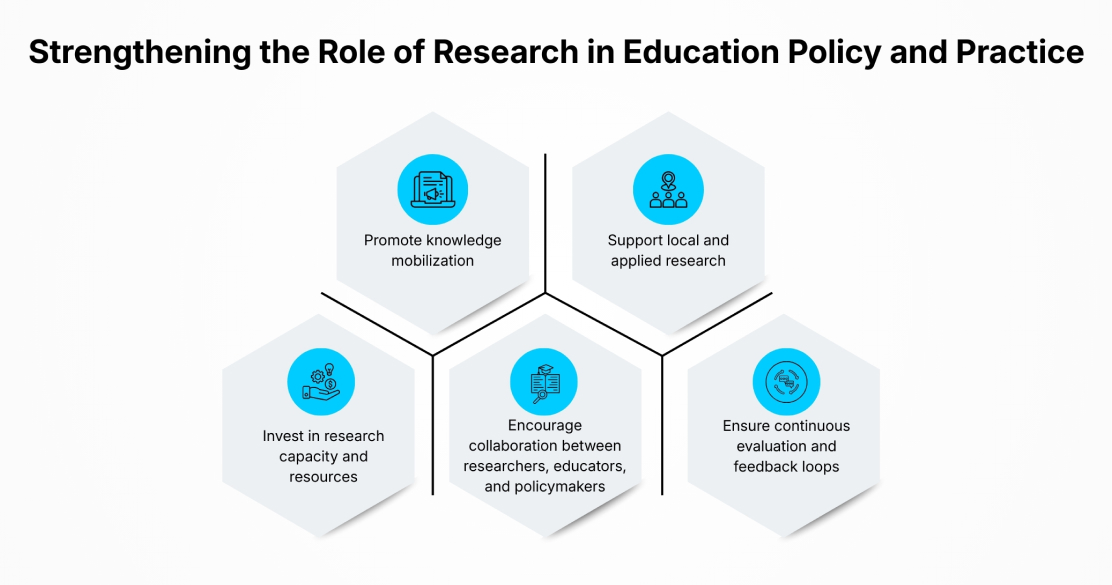
- Promote knowledge mobilization: Create intermediaries or platforms that translate academic research into practical guidelines for policymakers, educators, and administrators. This includes policy briefs, summary reports, and contextualised guidelines rather than full academic papers. The 2025 international survey on knowledge mobilization by OECD underscores that such structures improve take-up.
- Support local and applied research: Encouraging research that examines local educational issues such as cultural diversity, infrastructure variations, socio-economic inequalities, ensures that findings are relevant and actionable.
- Invest in research capacity and resources: Governments and institutions should allocate dedicated funding, build data-collection systems, and develop researcher training to sustain continuous inquiry.
- Encourage collaboration between researchers, educators, and policymakers: This helps align research questions with ground realities, design practically implementable solutions, and foster ownership of reforms.
- Ensure continuous evaluation and feedback loops: Regular monitoring, impact assessment and follow-up studies help validate reforms, scale effective practices, and abandon ineffective ones.
Conclusion
Research sits at the heart of meaningful, effective, and equitable education reform. By providing evidence, revealing disparities, testing pedagogies, and evaluating outcomes, educational research transforms education from a static tradition into a dynamic, evolving practice. Its influence extends beyond schools and classrooms: it shapes policies, guides resource allocation, and ensures that systems respond to changing social and economic needs.
Investment in research, whether through funding, capacity building, or knowledge dissemination, is not optional but essential. When properly integrated, research empowers educators, supports policymakers, and enriches student experiences. In a world where change is constant and knowledge evolves rapidly, research ensures that education not only keeps pace, but leads the way toward opportunity, innovation, and social equity.
Latest
Trends blogs
- From Paper to Proof: How Blockchain is Reshaping Academic Credentials
- Executive Education in the AI Era: Shifting Models and New Realities
- Global Education Technology: Growth Drivers, Challenges, and Evolving Trends
- Girls Shaping the Digital Future: Why ICT Skills Are a Must-Have for AI-Driven Careers
Focus blogs